
Core Banking Solution (CBS): Full Form, How It Works and the Role of AI
When you transfer money at midnight, check your balance on a mobile app or withdraw cash from an ATM in another city, a core banking solution is working quietly in the background. It is the digital backbone of modern banking, and without it, the instant, always-on experience customers expect would not exist. In this guide, we explain what a core banking solution is, its full form, how it functions, and how artificial intelligence is taking banking technology to the next level.
What Is CBS (Core Banking Solution)?
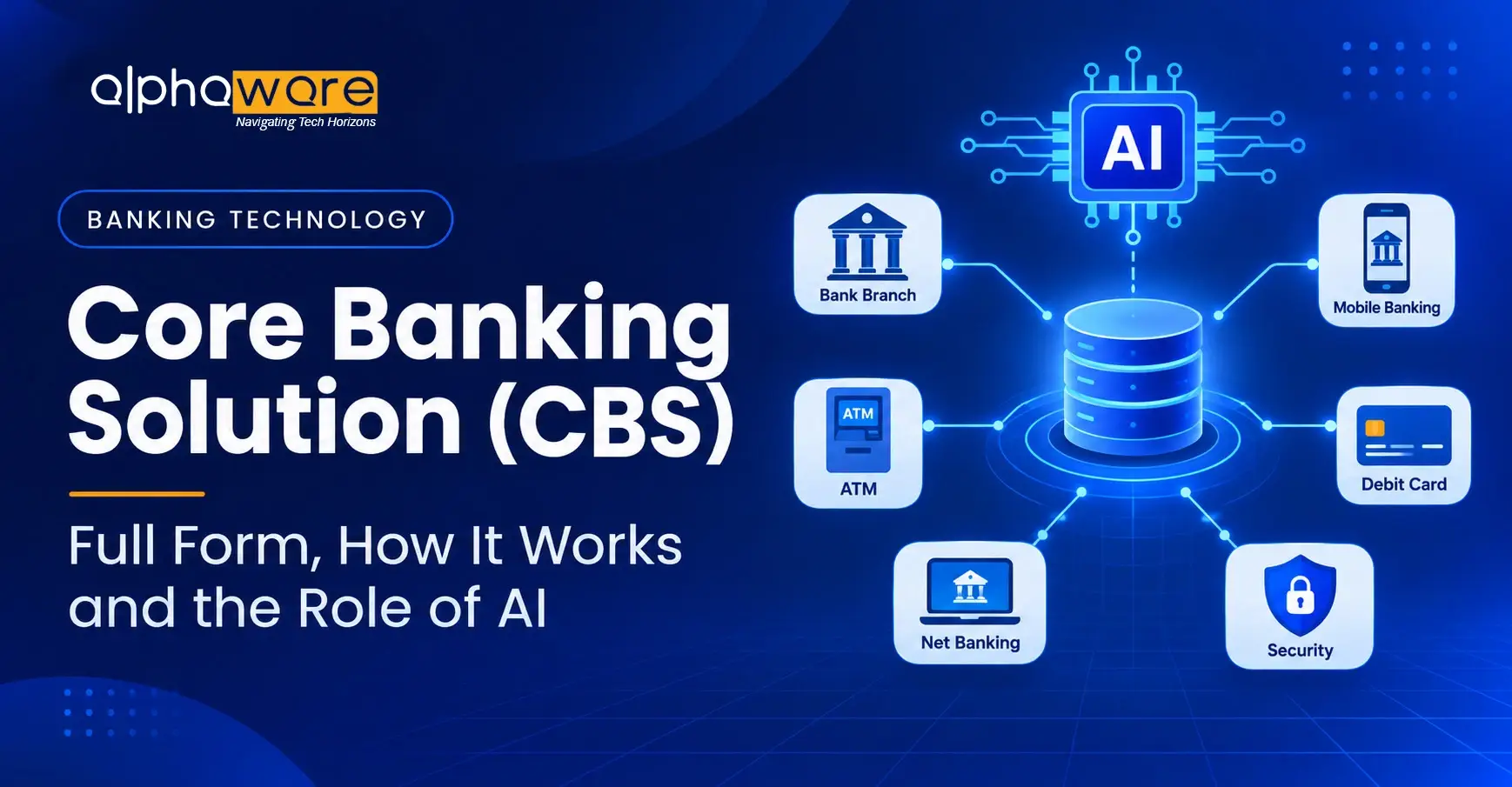
A core banking solution is a centralised software platform that banks and NBFCs use to manage their daily operations. It records and processes deposits, withdrawals, loans, payments, interest calculations and customer information in one place. Instead of every branch maintaining its own records, all branches connect to a shared system, so customers can transact from any location, not just the branch where they opened their account.
Think of a core banking solution as the central nervous system of a bank. Channels like mobile apps, internet banking, ATMs and branch counters are the limbs, while the core banking solution is the brain that keeps everything coordinated and consistent.
Core Banking Solution Full Form
The full form of CBS is Core Banking Solution. You may also see it written as Core Banking System. In the context of core banking solution in India, the word “core” is often explained as Centralised Online Real-time Exchange, which captures the idea that every branch and channel works on one live, connected network.
The word “core” refers to the central functions a bank cannot run without: maintaining customer accounts, processing transactions, managing loans and deposits, and keeping accurate ledgers. Anything built around these functions, such as a mobile app or a chatbot, depends on the core underneath.
Key Features of a Core Banking Solution
A modern core banking solution typically includes:
- Customer onboarding and KYC: Digital account opening, identity verification and document management.
- Deposits and withdrawals: Real-time updates across savings, current and fixed deposit accounts.
- Loan management: Application, underwriting, disbursal, repayment tracking and interest calculation.
- Payments and transfers: Support for UPI, IMPS, NEFT and RTGS.
- Customer relationship management: A unified view of each customer across products and channels.
- Accounting and reporting: General ledger, audit trails and regulatory reports.
- Security and access control: Role-based permissions, encryption and fraud monitoring.
How Does a Core Banking Solution Work?
At its heart, a core banking solution works on a simple principle: one central database, many access points. Here is how the process unfolds:
- A customer initiates a request. This could be a UPI payment, an ATM withdrawal or a loan application, made through any channel.
- The channel sends the request to the central server. The mobile app, ATM or branch terminal connects over a secure network to the data centre that hosts the platform.
- The system validates the request. It checks the customer’s identity, account balance, transaction limits and any risk or compliance rules.
- The transaction is processed in real time. Balances, ledgers and interest calculations are updated instantly in the central database.
- Confirmation goes back to the customer. An SMS, app notification or receipt confirms the transaction, and every branch sees the updated balance immediately.
Because every channel reads from and writes to the same database, there are no delays, mismatches or duplicate records. This real-time, always-on design is what makes 24×7 banking possible.
Benefits of a Core Banking Solution
For customers, a core banking solution means anytime, anywhere banking, faster service and consistent records across branches and digital channels. A farmer in a remote village can receive a subsidy directly into their account, and a business owner can deposit cash in one city and use it in another within minutes.
For banks and financial institutions, the advantages are equally strong:
- Operational efficiency: Automation reduces manual entries, errors and repetitive work.
- Lower costs: Centralised infrastructure reduces dependence on branch-level systems and manual effort.
- Better compliance: Reporting to regulators becomes faster and more accurate.
- Stronger security: Centralised controls make it easier to monitor and stop suspicious activity.
- Informed decisions: Unified data gives leaders a clear view of deposits, lending and risk.
Legacy Core Banking Solution Platforms and Their Limits
Many banks still run on legacy platforms built decades ago. These systems are reliable but rigid. Launching a new product can take months, integrating with fintech partners is difficult, and the batch-processing model means some updates happen overnight rather than instantly. As customers expect personalised, instant digital experiences, a legacy platform can become a bottleneck for growth.
This is why banks are moving toward modern, cloud-native and API-driven platforms, and increasingly, AI-enabled ones.
How AI Is Advancing the Core Banking Solution
Artificial intelligence is not replacing the core banking solution; it is making it smarter, faster and more adaptive. Here are the key areas where AI is making a difference.
1. Fraud detection and risk management
Machine learning models analyse thousands of transaction patterns in real time, flagging unusual behaviour such as sudden high-value transfers or logins from unfamiliar locations. When AI is embedded in a core banking solution, suspicious activity can be blocked before the money leaves the account.
2. Smarter credit decisioning
Traditional credit checks rely on limited data. AI models can assess a wider range of signals, including transaction history and repayment behaviour, to speed up loan approvals and extend credit to people who were previously overlooked, while keeping risk under control.
3. Personalised customer experiences
By studying spending habits and life events, Vehana AI helps banks recommend the right product at the right time, whether that is a savings plan, an insurance cover or a pre-approved loan. The data stored in the core banking solution becomes the fuel for these insights.
4. Automation of back-office work
AI-powered document processing and robotic process automation handle KYC verification, reconciliation and compliance checks in a fraction of the time. This frees teams to focus on higher-value work.
5. Conversational banking and voice AI
Chatbots and AI voice agents connect with the core banking solution to answer balance queries, explain charges, report lost cards and guide customers through services in multiple languages, around the clock.
6. Predictive analytics and compliance
AI can forecast cash-flow needs, predict loan defaults and automate regulatory reporting, helping banks stay ahead of risks rather than reacting to them.
7. Faster modernisation
AI tools are also helping banks migrate from legacy platforms by mapping data, generating code and testing integrations, shortening modernisation projects that once took years. A modern core banking solution makes it far easier to plug these AI capabilities in.
What to Look for in a Modern Core Banking Solution
Whether you are a bank, an NBFC or a fintech, here is what to prioritise:
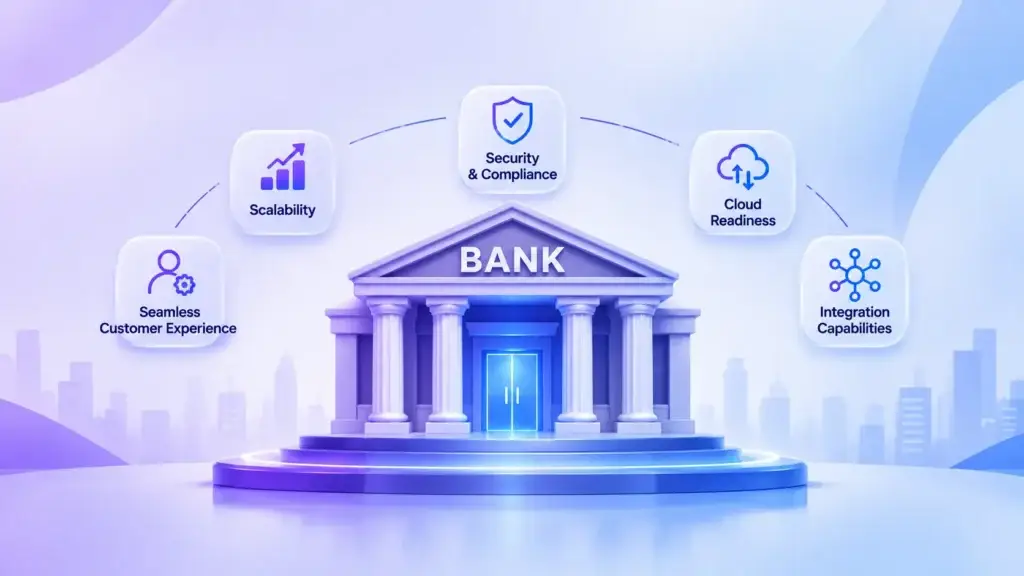
- Cloud-native, modular architecture that lets you add products quickly.
- Open APIs for easy integration with fintechs, payment gateways and AI tools.
- Real-time processing instead of overnight batches.
- Built-in security and compliance aligned with RBI and global standards.
- Scalability to handle growing transaction volumes.
- AI-readiness, with clean data and the ability to deploy models within the platform.
The Road Ahead
The future of banking will be defined by how well institutions combine a strong core with intelligent layers on top. A reliable core banking solution ensures accuracy and trust, while AI adds speed, personalisation and foresight. Banks that modernise now will be better placed to serve a digital-first generation.
Conclusion
A core banking solution is the foundation on which every modern banking service is built. It keeps accounts accurate, transactions instant and branches connected, and with AI layered on top, it is evolving from a record-keeping engine into an intelligent platform that detects fraud, personalises offers and automates compliance. Banks and NBFCs that invest in an AI-ready foundation today will be best positioned to compete tomorrow.
At Alphaware, we work at the intersection of AI and customer-facing teams. As banks adopt AI-led digital products, equipping relationship managers and sales teams to explain and sell them with confidence matters just as much as the technology itself.